Showing posts with label Steampunk. Show all posts

Sunday, November 10, 2013

Kiss of Steel by Bec McMaster


My Rating: 3.5 / 5.0

Amazon Rating: 4.60 / 5.00
Goodreads Rating: 4.01 / 5.00


Honoria Todd does her best to provide for her younger siblings, but it has not been easy since her father’s death. He was a scientist working to find a cure for the virus that transforms normal people into Blue Bloods, who gain longer life and greater strength but must regularly drink human blood. When her father was murdered, Honoria found herself a wanted woman desperately struggling to remain hidden whilst trying to earn enough money to keep her family fed. In order to find affordable housing, they are living in the Whitechapel area of London amongst the poorest and most dangerous people in the city.

Blade is a rogue Blue Blood who has broken away from The Echelon that runs the country to carve out his own small kingdom in Whitechapel. There, his word is law and everyone takes great care to avoid his notice. Unfortunately, his viral count is dangerously high and he is showing the first signs of becoming a Fade, a crazed monster that will be hunted down by the other Blue Bloods. Then he hears that a person of great interest is hiding in his rookery and he decides to find out why she is so important.


This title is billed as a both Paranormal Romance and Steampunk, leading me to believe that it might be similar to Gail Carriger’s Parasol Protectorate series, which I have thoroughly enjoyed (Soulless, Changeless and Blameless). However, it lacks the highly entertaining voice of Ms Carrier’s Alexia and relied much more on standard Romance elements and explicit sex scenes. This left both myself and the book group relatively entertained but not overly impressed.

For once, the depiction of British culture was not too bad, with some interesting ideas on display. The idea that the upper class would actively seek infection with the vampire virus, in order to live longer, seems perfectly reasonable to me. They exploit their position as the ruling class by molding British society to service their need for blood. Taxes are paid in blood donations, which I thought was an interestingly novel approach to the usual problem of blood supply whilst highlighting the Blue Blood’s view of normal human’s as somewhat similar to farm animals. However, the choice to give Rebel a broad cockney accent was a particularly bad one, especially as the author attempted to render his language phonetically. I can only imagine how difficult this made his dialogue for a non-Brit attempting to read it as I struggled to understand some sections. His accent was also very variable, so that it ended up being something akin to the absolutely awful ‘mockney’ accent that Dick Van Dyke offers in Mary Poppins, which is one of the worst attempts at a British accent that I have ever heard. I found that this choice added a barrier to the character and was totally unnecessary.

The world building was one area of the book that caused some problems amongst the book group members. Many were not familiar with Steampunk as a genre and so they were a little confused by some of the elements. However, we all agreed that there was too much description and info dumping, which slowed the story and yet did not describe the world adequately to allow us to visualize it properly. This was a shame because there were many interesting ideas, but it almost seemed like the author was too ambitious in the number of unique elements that she wanted to introduce with this title. It is the first in a series, so some of the detail and ideas could have been postponed until a later volume.

Honoria herself was a fairly admirable heroine, although the insta love and her irresistible animal attraction to Blade made her seem a little to two dimensional and lacking in my eyes. Indeed their whole relationship was far too idealized and moved too quickly for me to take it seriously. I would have preferred a slower burn of sexual tension, possibly lasting through several of the books in the series, but I am aware that Romance titles have to fulfill their quota of sex scenes and stick to the expected format. However, this awareness of genre expectations does not make me any happier about the rather overabundant use of sex in this book. It is not that I dislike reading sex scenes, merely that I expect them to have some relevance to the storyline or character development. In this case they were not engaging and made me want to skip past them, which is never a good sign.

As with Honoria, Blade was a little too stereotypical for me. When it was disclosed that his appalling accent was an assumed part of his disguise as a ‘tough man’ I think I nearly dislocated my eyes by rolling them so hard. Again, I understand that Romance readers like a good rogue who turns out to be a softy at heart, but I would have liked a little more deviation from that trope. This cheapened some of the relationships with his protected underlings because I never felt that he would live up to his blood-curdling reputation. By removing that threat of real menace he was severely reduced as an unexpected hero because it carried no surprise.

On the whole, this was a book that I was happy enough to complete, because I wanted to see where it went, but I have no interest in following the characters any further. They were far too shallow and true to type to hold my interest for long.


Other Reviews


Wednesday, December 19, 2012

The Last Page by Anthony Huso


My Rating: 1.0 / 5.0

Amazon Rating: 3.90 / 5.00
Goodreads Rating: 3.29 / 5.00


I decided to read this title because I received an ARC of the follow up book, Black Bottle, from Kristen at Fantasy Cafe.


Caliph Howl is a student, who seems suspiciously disinterested in graduating although he is more than competent. He spends a great deal of time having a rather un-romantic affair with Sena, a fellow student who is also a witch and was sent to the university to spy on him, because once Caliph leaves he will take up his seat as High King of Stonefield in the city of Isca. However, she has a secret mission of her own: to find the Cisrym Ta, an ancient text of powerful arcane magics.

When he finally accepts the inevitable and returns to Isca, Caliph finds that he must try to avoid a civil war whilst fighting to stay clear of those who want to manipulate him for their own political gains. He also uncovers some very disturbing secrets about how his kingdom functions. Meanwhile, a mysterious group begins to kill people and attempts to kill Caliph himself.


This book is bursting with imagination and originality, combining strange and unusual magic systems with steampunk technology and political intrigue. This all sounds very promising and rather refreshing as a change form the more typical fantasy offerings, but somehow it fails to gel into a cohesive novel.

I had several problems with my attempt to read this book, but I think the biggest is that there was far too little exposition for me actually understand and follow much of the detail: if there was ever a title that really needed a glossary and / or appendix, it is this one. There are multiple languages on show, although we very rarely find out what the words we see actually mean, which makes them irritating rather than interesting. I found this particularly strange because we did get foot notes for some things, but there needed to be many more. I am impressed at the imagination and attention to detail of creating several languages, but I am not impressed by having no idea what the characters mean or say using them. I found the same was true of the magic systems and even some of the technology. I do not need a twelve page thesis on every minor detail, but I do need some idea of how the world works. In general, I felt that Mr Huso’s boundless imagination was more of a hindrance than an advantage to my immersion in his world.

I had a similar problem with the language and writing style. Mr Huso likes to use obscure words, by which I mean words that have me reaching for the dictionary quite frequently. I am quite happy to expand my vocabulary, but when I discover that much more common words could be used to convey exactly the same meaning I start to get a little annoyed. I do not read fantasy novels so that I will be impressed by the author’s use of dictionary and thesaurus, but so that I can be transported to another world where I follow the exploits of some interesting characters. I am fairly confident that I have a relatively large vocabulary myself, as I do not normally need to use a dictionary whilst reading, so I felt that the book needed some serious editing to make the language much more accessible.

I also struggled with the plotting. I found it difficult to work out what were important pieces of information and what was simply detail. As with the world building, I felt as if information was being withheld from me and so I found myself confused about what was happening. It seemed as if important details were overlooked or excluded on purpose, so, for example, it took me ages to realize that Caliph was going to be the High King, because I had not read the book description before starting. There were also sections where the plot wandered around for no apparent reason, such as when Caliph went to Sena’s house. There were also a few ‘surprises’ or ‘twists’ that were sadly very predictable. Again, I was left with the uncomfortable feeling that the editor had been too overwhelmed by the imagination on display and had forgotten that a story has to be understandable to be appreciated.

Finally, the characters left me somewhat cold, especially Caliph. Sena was much more ‘real’ and better drawn, but even she seemed to follow no particular internal logic, which I always find amazingly annoying. Caliph does not want to be King and yet does not take the obvious way out by delegating to those men who had been running his military and other branches of government before he graduated. This did not make any sense to me and simply made him a really bad king. There were several interesting secondary characters, but they were not developed at all and were often forgotten in a most disappointing fashion.

In short, about half way through I decided that this title was far too much work for the minimal enjoyment that I was getting from it and gave up. I just wish that along with all the imagination Mr Huso had displayed an equal flare for communication. I needed to be drawn into his world and carried along by the plot, not left confused and bewildered. Obviously I will not be attempting Black Bottle.


Other Reviews I Recommend:


Friday, May 25, 2012

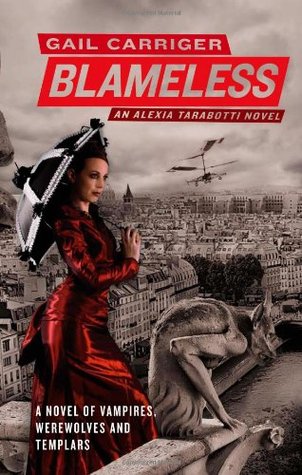
Blameless by Gail Carriger


My Rating: 4.5 / 5.0


Book 3 of "The Parasol Protectorate" 


If you have not read the first two books in the series I strongly suggest that you avoid this review. My reviews for them are here and here.


Once again Alexia is the scandal of London society. This time it is because she has left her husband and returned to the welcoming bosom of her loving family. However, when her family become aware of her ‘condition’, they do the most loving thing that they can think of and throw her out onto the street. Heading to the one person who will be happy to accommodate her scandalous personage, Alexia finds that Lord Akeldama has disappeared in a flurry of haste, although he has left her a mysterious message: “Check the cat”! As she drives away, trying to decide what to do next, she is attacked by a cloud of venomous, mechanical ladybugs that seem very determined to remove her housing problem permanently.

As she is obviously in mortal danger, with no hope of protection from Conall, she decides to take matters into her own hands. She needs to find out how she could be in possession of the ‘infant inconvenience’ and the only people who might have an answer are the Templars in Italy. Aided by Madame Lefoux and the ever-resourceful Floote, Alexia sneaks out of London to find proof that her stupid husband has made a terrible mistake and should be thoroughly ashamed of questioning her fidelity. Not that she wants him back: she just wants to make him admit that he was wrong!

Meanwhile, Lord Macon is dealing with the situation in the best way possible: by staying completely drunk.


As with the second book, Changeless, we see Alexia’s world expanding. Geographically, we move through France and Italy, which allows us to see how these two cultures have reacted differently to the total acceptance of the supernatural races that we see in Britain. This increases the complexity of the world quite significantly, especially once we get to Italy, which has little resemblance to our version of the country. The Italians actively seek out and destroy any supernaturals that they discover, using the magical properties of pesto to protect themselves. The whole idea that pesto is a way to make a person unpalatable to both races is simply delightful and indicative of how Ms Carriger’s fiendish mind works.

We also see a massive expansion in Alexia herself, and I do not mean in the size of her abdomen. As a preternatural, she had always assumed that she was basically heartless, but here we see that she feels emotions very deeply indeed. She is totally distraught by Conall’s rejection and refusal to believe her. She finds this all the more frustrating because she cannot think of a reason why she should be able to be pregnant by a man who is basically dead. Her grief and frustration turns to anger and she holds onto that fierceness whenever she falters. It is also very touching to see how she develops feelings for the ‘infant inconvenience’ as time goes on and she starts to become more comfortable with the idea of her situation. Kristen, at Fantasy Cafe, notes that some reviewers expressed dissatisfaction at the ending. I agree with her that it seemed perfectly in character to me: I think the problem may have been that Alexia is not a typical Romantic heroine and so she does not always act as we might expect.

Conall is given a rather minor role, which mostly consists of drinking vast quantities of formaldehyde in order to stay insensible. However, this allows the wonderful Professor Lyall to shine as he takes control of the Pack, tries to support his Alpha and solve the mysteries of the ladybug attacks and the disappearance of Lord Akeldama. To add to his troubles, various powerful werewolves attempt to steal the Alpha position whilst Conall is unavailable. Of course, Lyall rises to the challenge wonderfully and it was nice to see him acting independently. The same could be said of Ivy, who steps in to run Madame Lefoux's hat shop during their trip to Europe. She is now married to Tunstell and we see her being sensible and thinking for herself, which reminds us why Alexia chose her as a friend in the first place. Even Major Channing Channing of the Chesterfield Channings manages to develop and become less of an irritation.

We are introduced to several new characters, two of whom are other members of the Order of the Brass Octopus that Madame Lefoux seeks out for help. The first is her cousin, Gustave Trouve, who they meet in Paris. He is delightful and a faithful helper, even though he was the manufacturer of the deadly ladybugs. Later we encounter Mr Lange-Wilsdorf, a thoroughly repellent German who refers to Alexia as the ‘Female Specimen’ all the time, and seems to be unaware that she is a real person. He also has a horrible little dog that creates havoc and comes to the most glorious end: honestly, you will laugh out loud when you read it! However, I have to agree with Shara at Calico Reaction that the stand out character in the book is Floote. He turns out to be a seriously useful person to have around in a battle, as he remains totally unemotional and levelheaded throughout all the disasters that befall them. He is a glorious combination of P.G. Wodehouse’s Jeeves and James Bond: I want to see more of him in the later books, much more.

Unfortunately, we see very little of the spectacular Lord Akeldama. However, once he does arrive we are treated to some wonderfully romantic and poignant moments between him and Biffy. As Sparky says at Fangs for the Fantasy, it is beautiful to see their love for one another, and I am so pleased that such an open and honest homosexual relationship is treated with care and dignity. Lord Akeldama is a truly amazing character and to be allowed to glimpse behind his facade was genuinely touching.

Final factoid: in the UK, there are no ladybugs because we call them ladybirds!

Wednesday, May 16, 2012

Changeless by Gail Carriger


My Rating: 4.5 / 5.0

Amazon Rating: 4.10 / 5.00
Goodreads Rating: 3.98 / 5.00


Book 2 of "The Parasol Protectorate" 


If you have not read Book 1: Soulless I strongly suggest that you avoid this review. My review for Soulless is here.


Alexia Tarabotti, now Lady Maccon, is trying to come to terms with being Alpha female to the Woolsey pack when her husband dashes off on urgent BUR business. Unable to discover what the fuss is all about she goes down to breakfast only to find most of the Coldstream Guards setting up tents on her front lawn. Now she has to deal with the highly irritating Major Channing Channing of the Chesterfield Channings, mostly by beating him with her trusty parasol. Meanwhile a most unusual plague of normality has hit London: all the werewolves and vampires within a certain area have been returned to their human forms, whilst the ghosts have been exorcised. Queen Victoria demands that Alexia, in her role as Her Majesty’s Muhjah, investigate this plague and return the Empire to its previous happy state of supernatural dominance. As the investigation continues, Alexia finds herself travelling to that most appalling home of all that is tasteless: Scotland. She is accompanied by Miss Hisselpenny, who has just become engaged, but who still has a deplorable selection of hats; her sister Felicity, who has been so unbearable about their younger sister Evylin’s impending marriage that their mother has thrown her out of the house; Madame Lefoux a cross-dressing manufacturer of tasteful hats and usefully armed parasols; and Tunstell, one of Lord Maccon’s clavigers. They travel via dirigible, surviving several attempts on her life only to meet the redoubtable Lady Kingair, Alpha of the Scottish pack.

I am pleased to say that Ms Carriger has lost none of the wit and humor that she displayed in Soulless. Having much less exposition to deal with, we get a more detailed view of Alexia’s world and her relationship with Conall. It is always interesting to see if a romance relationship can still be realistic after the couple has ‘ridden off into the sunset’. Their dynamic has changed slightly, but there is still a lot of humor, frustration and sexual electricity: and we see how Alexia deals with being pack Alpha. The sections where Conall is proud of how strong she is are quite cute. She remains as strong and independent as she was in the first book, controlling her husband with a deft hand and beating Major Channing into submission when he dares to flirt with her. She has not become a simpering wife, thank goodness, but continues to be a worthy mate to the most powerful werewolf in the country.

The secondary cast continues to be strong. Unlike Shara at Calico Reaction, I didn’t find Ivy all that irritating: rather, I found her attempts at drama and attention-seeking funny, as they were met by indifference or snarky comments from Alexia. Indeed, Felicity was the one I wanted to throw over the side of the dirigible as she continued to make snide remarks about Alexia. Sparky at Fangs for the Fantasy has some objections about the portrayal of the gay characters. I agree that Lord Akeldama is almost a caricature of homosexuality: but I’m never quite sure how much of this is an act that he uses to disarm people. As for Madame Lefoux and her suits, this does seem a stereotypical way to portray a lesbian, but she is not described as being overly mannish or butch, although she does mimic a lot of male behaviors.

Kristen at Fantasy Cafe notes that the ending of the novel, which made me glad that I had book 3: Blameless to hand, also showed how much she was invested in Alexia. My anger and outrage was also proportionate with how much I really like this character and want her to be happy. As both Kristen and Lotte at Love Vampires note, there is much more steampunk on display in this book than the first: we have the dirigible, plus strange aethographic transmitters that allow long distant communications. As a sad scientist, I found the descriptions of these devices and how they work quite fascinating.

My major criticism, apart from the shocking ending, is that the source of the mysterious plague is all too easy to guess, which I found a little disappointing. 

Monday, April 30, 2012

Soulless by Gail Carriger


My Rating: 4.5 / 5.0


Amazon Rating: 4.30 / 5.00
Goodreads Rating: 3.94 / 5.00


Alexia Tarabotti is a constant source of embarrassment and disappointment to her mother. Not only did she inherit her Italian father’s dark hair and skin, with it’s propensity to tan, but she is also bookish, forward and not at all lady-like: it is enough to make poor Mrs Loontwill faint quite away. Fortunately, Alexia’s half-sisters, Felicity and Evylin, are the perfect of embodiment of respectable English girlhood: blond, fair-of-skin and empty-of-head. Adding to her strangeness is the fact that Alexia has no soul, a very rare affliction inherited from the long-dead Mr Tarabotti. Those humans gifted with an overabundance of soul are candidates for being turned into vampires or werewolves, and so living greatly extended lives, while others are held close to their bodies after death and become ghosts. All three types of supernatural live openly in human society and are regulated by Her Majesty’s Bureau of Unnatural Registry. Soulless preternaturals, such as Alexia, have the ability to negate the abilities of supernaturals, returning vampires and werewolves to their original human state and exorcising ghosts, all with a simple touch; and so we start our story . . .

Alexia is attending a terribly dull ball and has retreated to the library to enjoy some treacle tart in peace, when she is accosted by an impudent vampire. Not only does he not introduce himself, displaying the worst manners imaginable, but then he attempts to bite her without first asking for permission. He is totally confused by his inability to actually accomplish the biting, as he has never heard of a preternatural and cannot understand why his fangs keep disappearing whenever he touches her. When reasoning proves to be futile she makes use of her wooden hairpin and trusty parasol to stake the ruffian. This incident brings Alexia into conflict with the unforgivably Scottish Lord Maccon, head of the BUR and Alpha of the London werewolves. She relays her surprise that the vampire was unaware of her nature, as the few new vampires created by the local hives are always well educated about preternaturals, or that he should be allowed about town in such awfully cheap clothing.

As the number of ill-educated, new vampires appearing in London increases, Alexia finds that everyone suspects her of masterminding the phenomenon. Whilst trying not to give her mother cause to have an attack of the vapors, she seeks advice from an independent vampire, the outrageously extravagant Lord Akeldama, who uses his group of devilishly handsome young men to collect all the gossip and intrigue from around town. Unfortunately, he does not know who is responsible, and she is repeatedly ordered to desist by Lord Maccon, but Alexia has never been the type to take advice, even if it is delivered by a powerful werewolf who is in turns angry and physically affectionate. While she cannot quite accept that Lord Maccon might be interested in her as a woman, Alexia continues to make enquiries as she seeks to uncover the true nature of these new vampires. 


I have to admit that I spent a great deal of time chuckling whilst I read this book. The name of the series that it begins, The Parasol Protectorate, is indicative of the humor that fills the writing. The author’s turn of phrase is delightfully sharp, although it captures the overly wordy style of writing of the period, which is Victorian. Unlike Sarah at Bookworm Blues, who found this problematic, I found it drew me into the world very successfully. Of course, I am British myself, so I may find it easier to associate myself with an Alexia who is not only witty but also has a cutting, sarcastic tone.
“How ghastly for her,” said Alexia, driven beyond endurance into comment. “People actually thinking, with their brains, and right next door. Oh the travesty of it all.”

Alexia is a fearless heroine who fights her own battles: and in a full skirt and corset with a bushel and hat to contend with. She knows that she is not really a part of the High Society that the rest of her family inhabits, but she genuinely doesn’t care and is unashamed of her differences. So, in many ways, she seems like a very modern woman. However, she is limited by some of the mores and expectations of her time and never really pushes the bubble so far that she feels out of place in the Victorian period. In many ways she reminded me of Lauren, the heroine in Mary Ballogh’s A Summer to Remember, that I read at about the same time. It is so nice to have a period character who shows some backbone, but is not too anachronistic.

All the other main characters are very well drawn. Lord Maccon is a bad-tempered bear of a man, who seems to have great difficulty behaving in an acceptable way, and relies upon his Beta, the diminutive Professor Lyall, to deal with the niceties of most situations. Alexia tries to escape her air-headed, fashion and marriage obsessed mother and sisters as much as possible. She can always depend upon Miss Ivy Hisselpenny to join her for a turn around the park and a good gossip, although Ivy’s totally disastrous taste in hats is a major flaw that Alexia has learnt to tolerate. Her other great confidant, Lord Akeldama, is a wonderfully affected character who constantly seems to speak in italics and is so flamboyantly gay that he is almost universally despised by everyone else that she knows, but she loves him dearly, mainly because he seems to genuinely like her for who she is. These are fun people, and I can imagine that they would be very entertaining to spend time with.

The story moves along fairly well, though the pace is a little uneven, but the writing itself is enjoyable enough to overcome this. The world is well drawn, with lots of detail and different enough from historical Victorian London to show a little of the Steampunk aspects that become more prominent in the second book in the series. The Romance elements were handled with an air of confusion, but I felt that this conveyed Alexia’s own reactions to Lord Maccon’s advances. There is a great deal of sexual tension between the two, with increasingly urgent sessions of fumbling, but the relationship proceeds in a stop-start fashion, as they both fight to control their urges. Kristen at Fantasy Cafe found this emphasis on physicality a little boring, but I felt this demonstrated both his animal instincts and her ‘soulless’ lack of romantic sensibilities.

The Book Smugglers found Alexia to be extremely similar to Elizabeth Peter’s Amelia Peabody and they also had other criticisms, which were shared by several reviewers on Goodreads that were ambivalent or negative about the book. I can’t comment on the similarity to Peter’s books, but many of the negativity seems to be due to the genre labels used to market the title and the hype associated with its promotion. I can understand how disappointing it can be when you start a book expecting one thing and getting something entirely different. I have also had the experience of reading a famously popular book that ‘everyone’ has raved about, only to wonder if I am reading the same thing that they did . . . ‘The Girl With The Dragon Tattoo’ by Stieg Larsson springs to mind instantly. All I can say is that I thoroughly enjoyed my journey through Alexia’s world: I have already read the second book in the series, ‘Changeless’, and the third, ‘Blameless’ is sitting on my coffee table as I type. 

Link Within

Related Posts Plugin for WordPress, Blogger...