Friday, May 25, 2012

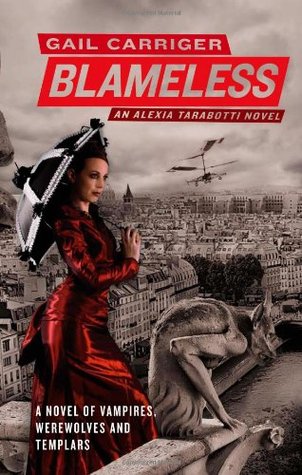
Blameless by Gail Carriger


My Rating: 4.5 / 5.0


Book 3 of "The Parasol Protectorate" 


If you have not read the first two books in the series I strongly suggest that you avoid this review. My reviews for them are here and here.


Once again Alexia is the scandal of London society. This time it is because she has left her husband and returned to the welcoming bosom of her loving family. However, when her family become aware of her ‘condition’, they do the most loving thing that they can think of and throw her out onto the street. Heading to the one person who will be happy to accommodate her scandalous personage, Alexia finds that Lord Akeldama has disappeared in a flurry of haste, although he has left her a mysterious message: “Check the cat”! As she drives away, trying to decide what to do next, she is attacked by a cloud of venomous, mechanical ladybugs that seem very determined to remove her housing problem permanently.

As she is obviously in mortal danger, with no hope of protection from Conall, she decides to take matters into her own hands. She needs to find out how she could be in possession of the ‘infant inconvenience’ and the only people who might have an answer are the Templars in Italy. Aided by Madame Lefoux and the ever-resourceful Floote, Alexia sneaks out of London to find proof that her stupid husband has made a terrible mistake and should be thoroughly ashamed of questioning her fidelity. Not that she wants him back: she just wants to make him admit that he was wrong!

Meanwhile, Lord Macon is dealing with the situation in the best way possible: by staying completely drunk.


As with the second book, Changeless, we see Alexia’s world expanding. Geographically, we move through France and Italy, which allows us to see how these two cultures have reacted differently to the total acceptance of the supernatural races that we see in Britain. This increases the complexity of the world quite significantly, especially once we get to Italy, which has little resemblance to our version of the country. The Italians actively seek out and destroy any supernaturals that they discover, using the magical properties of pesto to protect themselves. The whole idea that pesto is a way to make a person unpalatable to both races is simply delightful and indicative of how Ms Carriger’s fiendish mind works.

We also see a massive expansion in Alexia herself, and I do not mean in the size of her abdomen. As a preternatural, she had always assumed that she was basically heartless, but here we see that she feels emotions very deeply indeed. She is totally distraught by Conall’s rejection and refusal to believe her. She finds this all the more frustrating because she cannot think of a reason why she should be able to be pregnant by a man who is basically dead. Her grief and frustration turns to anger and she holds onto that fierceness whenever she falters. It is also very touching to see how she develops feelings for the ‘infant inconvenience’ as time goes on and she starts to become more comfortable with the idea of her situation. Kristen, at Fantasy Cafe, notes that some reviewers expressed dissatisfaction at the ending. I agree with her that it seemed perfectly in character to me: I think the problem may have been that Alexia is not a typical Romantic heroine and so she does not always act as we might expect.

Conall is given a rather minor role, which mostly consists of drinking vast quantities of formaldehyde in order to stay insensible. However, this allows the wonderful Professor Lyall to shine as he takes control of the Pack, tries to support his Alpha and solve the mysteries of the ladybug attacks and the disappearance of Lord Akeldama. To add to his troubles, various powerful werewolves attempt to steal the Alpha position whilst Conall is unavailable. Of course, Lyall rises to the challenge wonderfully and it was nice to see him acting independently. The same could be said of Ivy, who steps in to run Madame Lefoux's hat shop during their trip to Europe. She is now married to Tunstell and we see her being sensible and thinking for herself, which reminds us why Alexia chose her as a friend in the first place. Even Major Channing Channing of the Chesterfield Channings manages to develop and become less of an irritation.

We are introduced to several new characters, two of whom are other members of the Order of the Brass Octopus that Madame Lefoux seeks out for help. The first is her cousin, Gustave Trouve, who they meet in Paris. He is delightful and a faithful helper, even though he was the manufacturer of the deadly ladybugs. Later we encounter Mr Lange-Wilsdorf, a thoroughly repellent German who refers to Alexia as the ‘Female Specimen’ all the time, and seems to be unaware that she is a real person. He also has a horrible little dog that creates havoc and comes to the most glorious end: honestly, you will laugh out loud when you read it! However, I have to agree with Shara at Calico Reaction that the stand out character in the book is Floote. He turns out to be a seriously useful person to have around in a battle, as he remains totally unemotional and levelheaded throughout all the disasters that befall them. He is a glorious combination of P.G. Wodehouse’s Jeeves and James Bond: I want to see more of him in the later books, much more.

Unfortunately, we see very little of the spectacular Lord Akeldama. However, once he does arrive we are treated to some wonderfully romantic and poignant moments between him and Biffy. As Sparky says at Fangs for the Fantasy, it is beautiful to see their love for one another, and I am so pleased that such an open and honest homosexual relationship is treated with care and dignity. Lord Akeldama is a truly amazing character and to be allowed to glimpse behind his facade was genuinely touching.

Final factoid: in the UK, there are no ladybugs because we call them ladybirds!

Thursday, May 24, 2012

New to the Coffee Table


This week I am only listing one new book because I have been very self-controlled and not applied for any giveaways in the last week or so. Giveaways are a way for authors to create some buzz for the books and so they ask for reviews in return for the free books. I already have a pile of them sitting on my coffee table, or my Kindle, and I really do need to read and review them. The guilt is starting to get to me, so I have decided to restrain my urge to gather up as many free books as I can possibly get. It is times like this that I am glad that I am only a small blogger and do not get ARCs thrown at me: I could never live with the guilt of not reading them all!

Who would ever think that free books could be a bad thing!? :D

The description is from Goodreads.


Fire: Elements of the Undead by William Esmont (LibraryThing Member Giveaway)

Elements of the Undead #1

It begins with the end...

When Megan Pritchard clocks in for her late night shift in a Nevada brothel, she has no way of knowing it will be her last. Around the world, the dead are rising, and mankind is on the express train to extinction. As her coworkers turn into cannibalistic zombies, Megan is forced to flee into the desert with nothing but the clothes on her back and a vague plan to reach her sister in southern Arizona.

Facing impossible odds, Megan embarks on a journey of self discovery, only to learn she may be the last, best hope for humanity.

Wednesday, May 23, 2012

Special Needs in Strange Worlds: The Ship Who Sang by Anne McCaffrey


My Rating: 4.5 / 5.0


For my first ever Guest Review you can find me over at Bookworm Blues, where Sarah has been hosting a month-long event with the title Special Needs in Strange Worlds. The event looks at the portrayal of disabled people of all types in the Speculative Fiction genre and has produced some very thought provoking posts from the other guests. Sarah was originally inspired to run the event because of this post by Elspeth Cooper and it is a subject dear to her heart because she has had major disability and illness to overcome, as she explains here.

If you have not been to Bookworm Blues before, then I highly recommend it. Sarah has a very entertaining voice and produces interesting and enlightening posts. I always look forward to her posts appearing on my RSS feed grabber because I know that they will be thoughtful and thought-provoking. You can also follow her on Twitter and Goodreads.

Tuesday, May 22, 2012

Kiss of Crimson by Lara Adrian


My Rating: 4.0 / 5.0


This is the second book in the Midnight Breed series. My review of the first book, Kiss of Midnight, includes some background to this book and the world in which it is set. If you have not read the first book yet, I would suggest that you avoid this review as it contains spoilers about it.


Dante, one of the Warriors that protect the Breed, thinks that he is facing a normal Rogue, but it is unaffected by the touch of his titanium-infused dagger. Still, he runs after this new menace, determined to stop it before it can wreak havoc on the city. However, when he finally has it cornered and can decapitate it, he comes under fire from a concentrated hail of bullets and has to dive into the river to escape. Terribly injured, he eventually crawls into the veterinary clinic of Tess Culver. He instinctively feeds on her, but then removes all trace of himself from her memory. However, as he is leaving, he sees the unmistakable birthmark that shows that she is a Breedmate, and he has started the process of claiming her by drinking from her.

Haunted by the vision of his death, Dante does not want to take Tess as his Mate, but he is drawn to her. Then she becomes tangled up in a new threat to the Breed’s safety caused by a drug that creates a new type of super-Rogue from the young vampires that take it for recreation. Although he wants to protect her from himself and his world, Dante must put his misgivings aside as they work together to find the source of the drug and prevent the new Rogues over-running the both human population and the Breed itself.


As with the earlier book, this is most definitely a Paranormal Romance. The main characters are engaging enough, with sufficiently unusual backstories to make them interesting. Fortunately, they are slightly less irritating about their obvious attraction to one another when compared to Gabrielle and Lucan in the first book. The secondary characters fair reasonably well and the adorable little dog, Harvard, is a nice addition to the dysfunctional family. The drug pushing baddy was suitably amoral and ruthless, although I almost felt sorry for him by the end.

I was interested in the plot strand involving the Breed detective, Chase, and his widowed sister-in-law, Elise. It was good to get an idea of how the non-Warrior, ‘normal’ vampires lived in the Darkhaven because it emphasized their similarity to their human Breedmates. We got a better idea of what it would be like to live within this community and the grief that Elise endures for her dead husband and the terror she feels for her missing son are very well done. The drug plot line was interesting and meant that the Warriors had a new enemy to confront, rather than just a simple re-hash of the Rogue build-up that we saw in book one. This created more of a sense of danger, making the enemy a real threat. I liked the addition of Breedmate talents that I do not remember being shown in the first book. Again, this added more depth to the characters and the world, as well as providing some very handy ways to move the plot along.

However, I did have some disappointments. I would have liked to have seen much more of Gabrielle and Lucan. I wanted to know how their relationship was progressing, especially as I could imagine Lucan would be somewhat difficult to house train! Unfortunately, they are barely mentioned and they are now happily married, just like Gideon and Savannah, which is a little boring. I was also disappointed that the story was so tightly focused on the Tess / Dante love story and was opened out to show more of the Warriors in action. There was a feeling that they were simply sitting in the bunker knitting socks or something when they were not included in the action.

Overall I did enjoy this second excursion into the Midnight Breed universe. As the reviewer at Love Vampires says, it is a face-paced romp, with a nice balance of action and romance. The Pedantic Phooka remarks that we are left with some open ended plot lines as Chase and Elise still have unfinished business at the end of the book, which is promising. However, I am not sure that I want to keep returning to the series if each story concentrates so much on a single pair of characters. 

Monday, May 21, 2012

Read Along of Neverwhere by Neil Gaiman: Part 1


You can see Carl’s Part 1 post, and the links to the other blogs taking part, here.

If you haven't read the book, or even if you have, why not join in and read along with the rest of us? This week we have read up to the end of Chapter 5.

Before I get to the questions I have to confess that I had the most incredible case of deja vu when I started the book. It turns out that I saw the original TV series on the BBC back in 1996, so I think I know the identity of the evil person who is after Door, but I am not totally sure.


1.  What do you think of our two villains thus far, Messrs. Croup and Vandemar?

They are really repulsive, and have some seriously dangerous talents. Plus Mr Vandemar eats raw mice: barf! I am creeped out by their ability to move around way too quickly, which seems to be some sort of teleportation. I am intrigued by the interplay between them, with Mr Croup acting as the brains to Mr Vandemar’s brawn. I like the overly grandiose and slightly antiquated language that Mr Croup uses, although he does seem to suffer from verbal diarrhea. I am repulsed by, but also curious about, Mr Vandemar’s magical spit, which seems to be some form of natural super glue. That scene where he purposely knifed his hand to the wall was jaw-dropping on so many levels. 


2.  Thus far we've had a small taste of London Below and of the people who inhabit it.  What do you think of this world, this space that lies within or somewhat overlaps the space the "real world" occupies?

It is obviously a very harsh and unforgiving world, but also very sad. I cannot imagine that it is easy to survive in a world where you are unable to return to your previous life because you do not exist anymore. I am intrigued by the lack of obvious theft from London Above, as the invisibility would make this a perfect way to make a living. I assume that will be explained at some point. The inhabitants of London Below do not seem to be only the homeless and forgotten. There are those who have been born and raised there, such as Door, and I can imagine that some find their way there because it fits their way of life or talents.


3.  What ideas or themes are you seeing in these first 5 chapters of Neverwhere?  Are there any that you are particularly drawn to?

There is a steampunk feel to some of the dress and mechanisms that we have seen so far, but my overall impression is of darkness and dirt. There is also a surreal feel to almost everything, with characters that are teetering on the edge of madness and settings that come straight out of nightmares. The whole world is built from rubbish by people who have been discarded by society for a variety of reasons. I get the distinct impression that this world is the human equivalent of the life that one can see when one lifts up a rock. I am most drawn to understanding how the two Londons interact with one another.


4.  We've met a number of secondary characters in the novel, who has grabbed your attention and why?

At the moment I am most intrigued by the Hunter, probably because she is so ‘normal’ in many ways and yet so supernatural in others. I hope we will learn more about her. I was very taken by Anesthesia, as she seemed like a fundamentally nice kid. Her death was quite a shock.


5.  As you consider the Floating Market, what kind of things does your imagination conjure up? What would you hope to find, or what would you be looking for, at the Market?

It sounds like a moving junkyard in many ways. It would be interesting to see what exactly some of the stalls are offering and how useful things have been crafted from rubbish. I noticed that Door mentioned a group of Roman legionaries that seem to speak Latin, so I would be hoping to find them or some Roman era artifacts. What can I say? I think I was probably a Roman in a previous life because I find them so fascinating.


6.  If you haven't already answered it in the questions above, what are your overall impressions of the book to this point?

It is grim and dark, depicting a cruel, merciless world. I like the way reality has been twisted slightly to create a whole world of fantastical nightmares.

Sunday, May 20, 2012

A Challenge of Ice and Fire: Week 7


A Clash of Kings: Prologue to the end of Tyrion II (p.135)


0. Prologue

We get to meet Stannis and his family. Wow, what a joyful bunch they are!

Stannis himself is a joyless, self-righteous idiot who broods on any and all past wrongs and has a bigger case of entitlement than Joffrey, which is really saying something. I am not saying that Robert was the best brother ever, but I am not sure that he could have never made Stannis happy, no matter what he did. This makes Stannis’ involvement in the hunt for the Bastards all the more interesting, as I cannot work out why he wanted to uncover them. He and his wife, Selyse, seem to be well matched, as they are both narrow minded and cold. I feel truly sorry for their daughter, Shireen, who not only has to live in this miserable atmosphere, but who is also permanently disfigured by a childhood illness: she seems really sweet, so I foresee horrible things happening to her. The story of Patchface is tragic indeed, though he seems to be some sort of savant with his nonsense songs. Ser Davos has an interesting back-story: although I am not sure why he brought food through the blockade to be rewarded by having his fingers amputated. This in itself shows quite neatly why Renly will gather more support than Stannis.

That brings us to Melisandre. It seems unusual that her religion is trying to recruit converts, as we have already seen that there is no animosity between the followers of the Old Gods and the Seven in Westeros. Maybe it is just me, but the ‘Lord of Light’ name makes me think of Christianity with its monotheism replacing the polytheism of the older religions. I was disgusted, but not surprised by Stannis’ dismissal of poor old Maester Cressen: Stannis seems the type to shoot a faithful old horse once it is of no further use. It was very sad to see Cressen sacrifice himself for the boy he loved as a son, but amazingly creepy that Melisandre had no fear of the poison.


1. Arya I

Arya is sometimes too feisty for her own good, but that is one of the things I like about her. Yoren confirms that the plan was to let Ned take the Black, which confirms what we feared about Joffrey ignoring the Small Council’s advice. Arya tries to blend in with the rabble that Yoren is leading north, but she is the smallest by quite a bit, so she is an obvious target for some of the other boys. Instead of holding her tongue she loses her temper and beats the snot out of Hot Pie. This is not a smart way to be inconspicuous, but it is what we expect from our warrior princess. Yoren makes sure that she understands how dangerous her situation is, but I am not sure how long that will last. I really liked her wish to be with Jon on the Wall: the connection between the two is so very strong and simply emphasizes the fact that they are the ones who actually look like Starks, whereas the other children take after Catelyn’s Tully family.


2. Sansa I

So, I am not sure who would win in a competition of worse castle to live in: Sansa or Shireen. Shireen at least is safe from harm, just living in a morbidly depressing atmosphere, whereas Sansa has to play nice to avoid upsetting the psychopath that is Joffrey. Where is Drogo with a nice ‘gold crown’ when you need him? Joffrey is so delusional that I really do hope that he gets his wish of challenging Robb to single combat: even without Grey Wind, Robb would beat the jumped up little shit into the dirt. Heck, even Rickon would manage it with very little sweat. It was nice to see that Tommen and Myrcella are actually not devil-spawn like their brother, so there is hope for the Lannisters after all. I loved their reaction to Tyrion. It is so great to see how children can accept people who are different, and it was nice to see his genuine affection for them. He was also kind and thoughtful in his dealings with Sansa, even though their families are at war, which only highlights Cersei and Joffrey’s pettiness and petulance. I have to wonder where their evil genes come from . . .


3. Tyrion I

The Mighty Tyrion gets to be the Hand, much to Cersei’s disgust, which makes me cheer for him even more than usual. Her stomping petulance about Lord Tywin’s refusal to do her bidding made me laugh, but mostly I loved how Tyrion told her a few home truths in the bluntest way possible. I am still amazed that Tywin does not know about the twins’ incest, but maybe he has always been too busy to notice. Tyrion will be a very good Hand and he will do a far better job of running the city than Cersei, mainly because he actually seems to care about the common people or, at the very least, he realizes that they have to be appeased so that they will not rise in rebellion. Varys has found Shea: he really is spooky in his ability to know everything that happens. I loved the shadow boxing that he and Tyrion engage in about this significant point of leverage in Varys’ favor.


4. Bran I

Bran howling with the wolves was a very eerie scene, but I really like how he does not listen to everyone else’s ideas about them: he understands that they are different from the dogs and wonders just how different. The red comet is becoming a repeated motif as everyone speculates on what it might portend. Of course, we know that Old Nan is right: it means the reappearance of dragons. I like how everyone turns the comet into a sign for the coming of whatever they most want, apart from Maester Luwin who sees it as simply an astronomical phenomenon. We get to meet the two Walders, who will play an important role at some point, assuming that Shaggydog does not manage to eat them first. I am uneasy about the wolves being locked in the Godswood, especially Shaggydog, who seems to be angry all the time. It suggests that Rickon is being ignored and not being cared for properly. Bran continues to have his wolf dreams. I cannot help thinking that Osha has an idea what this means, but she is staying quiet at the moment. Bran seems to be displaying a lot more wisdom these days, which I guess comes from him spending more time thinking, and he is much more open minded and connected to nature than those around him.   


5. Arya II

Do we think that Nymeria might be the mystery she-wolf plundering the area? Oh yes! I hope that she and Arya are reunited very soon as they would be a formidable pair and Arya could ride her like a horse. Plus, she is befriending Gendry, which is a neat echo of their fathers’ relationship. I am glad that he managed to escape King’s Landing, although I wonder who sent him to Yoren: Varys, I imagine. I am not all that happy about her associating with the raving lunatics in the cart though: seriously, who sharpens their teeth into points? Jaqen sounds reasonable enough, but he keeps seriously bad company and must be a real badass if they have not murdered him yet. The brush with the gold cloaks was very unwelcome, although it was strange that they were searching for Gendry and not Arya. I suppose that, as a girl, she is not supposed to be capable of surviving this long or getting out of the city.


6. Jon I

How much do I love Sam and his geekiness? Quite a lot, actually. He has exactly the same reaction that I would to the documents stored under Castle Black: no wonder he lost track of time. The armorer, Donal Noye, has an interesting assessment of the Baratheon brothers: Robert was true steel, Stannis is brittle iron and Renly is flashy copper. We will see if he is right in time. I loved the story of how Maester Aemon refused the crown: he is such an intriguing character, with a wealth of knowledge and wisdom. I like how the Old Bear uses Aemon’s story to feel out Jon’s intentions now that Robb is the King in the North: the Night’s Watch were very lucky when Mormont decided to take the black.


7. Catelyn I

Robb acting as King is a sight to behold, as he wields his power like a seasoned professional. Obviously, Cersei will not agree to the terms that he sends, but an effort must be made. Catelyn realizes that he is no longer under her control, but his own man with his own ideas. However, in a nice contrast to Cersei, she takes this well and tries to guide him rather than force his hand. I suppose that it helps that he is not a psychopath like Joffrey; so that his decisions are not too far from those that she would make herself. Unfortunately, they do not seem to be a good position at the moment, with a new army amassing at Casterly Rock and the river lords split up protecting there own holdings. It looks like they need a plan.


8. Tyrion II

I so enjoyed Tyrion’s disposal of Janos Slynt. It was subtly done, but fairly obvious: no Hand could ever trust the man after he had betrayed Ned. This is especially true when he is so quick to do stupid things just because the idiot Joffrey decides to entertain himself. I loved Slynt trying to be rude to Tyrion because he is not a Lord: no, Slynt, he is the son of probably the most powerful Lord in Westeros and the King’s uncle! What an idiot! I am not happy that Slynt is off to the Wall with his cronies though, even if one of them has an ‘accident’ on the way: I was hoping that Tyrion would make good on his pledge to support the Night’s Watch. I liked the debate that he has with Varys about Power. I normally find politics somewhat dull, but this was fascinating, especially as there were so many things hinted at and insinuated. Also, Varys gets a plus point for saving Gendry: all I need to work out now is why he did it.

Link Within

Related Posts Plugin for WordPress, Blogger...